Monday, March 11, 2013

Artist of the Week: Jimi Hendrix


THE SETTING: Horace Mann Elementary School, Seattle, WA (Mid-1950s)


Perhaps this looks a bit like Jimi Hedrix's first guitar...
Hendrix's habit of carrying a broom with him to emulate a guitar gained the attention of the school's social worker. After more than a year of his clinging to a broom like a security blanket, she wrote a letter requesting school funding intended for underprivileged children insisting that leaving him without a guitar might result in psychological damage.


Flash forward 20 years:


Jimi Hendrix
An American musician, singer and songwriter. 
b.  November 27, 1942
d.  September 18, 1970 (27 years old)

Having lived such a short life, he was in the mainstream for only four years (1966-1970).  See his full chronology by clicking here.  He made such a significant impact in that short span of time.


Jimi Hendrix Interview--The Dick Cavett Show


DESPITE a limited mainstream exposure of four years, he is widely considered one of the most influential electric guitarists in the history of popular music, and one of the most important musicians of the 20th century.


MUSICAL INFLUENCES
OF Muddy Waters, the first guitarist Hendrix became aware of, he said: "I heard one of his records when I was a little boy and it scared me to death because I heard all of these sounds."


MUDDY WATERS


I don't happen too know much about jazz. I know that most of those cats are playing nothing but blues, though—I know that much.
—Hendrix on jazz music

Elvis Presley, Little Richard and Chuck Berry Muddy Waters, Elmore James and B.B. King Eddie Cochran Muddy Waters Jimmy Reed, Albert King. Howlin' Curtis Mayfield


ELVIS PRESLEY


CURTIS MAYFIELD

VIDEOS
Early career playing in the US playing back-up for Buddy and Stacey and the Upsetters, May 1965


UK:  The Jimi Hendrix Experience
Jimi Hendrix and the Experience


His showmanship and virtuosity made instant fans of reigning guitar heroes Eric Clapton and Jeff Beck, as well as Brian Jones and members of the Beatles and the Who, whose managers signed Hendrix to their new record label, Track Records.

When Track records sent the master tapes for "Purple Haze" to Reprise for remastering, they wrote the following words on the tape box: "Deliberate distortion. Do not correct." First released in the UK in May 1967, Are You Experienced, reached number 2 in the UK charts. The original version of the LP contained none of the previously released singles or their B-sides.


"The Jimi Hendrix Experience" first TV appearance in Belgium, 1966


"The Jimi Hendrix Experience" UK  TV appearance, 1969


Although very popular in Europe at this time, the Jimi Hendrix Experience had yet to crack the United States.


Their chance came when Paul McCartney recommended the group to the organizers of the Monterey International Pop Festival. This proved to be a great opportunity for Hendrix, not only because of the large audience present at the event, but also because of the many journalists covering the event who wrote about him.


His Rock Hall biography states "Jimi Hendrix was arguably the greatest instrumentalist in the history of rock music. Hendrix expanded the range and vocabulary of the electric guitar into areas no musician had ever ventured before. His boundless drive, technical ability and creative application of such effects as wah-wah and distortion forever transformed the sound of rock and roll." Musicologist Andy Aledort described Hendrix as "one of the most creative musicians of all time."


Jimi Hendrix Interview--The Dick Cavett Show


Jimi Hendrix Interview--The Dick Cavett Show (The Star Spangled Banner)


WOODSTOCK, 1969


Performing at Woodstock


For an article by the NY Times on Woodstock, click here


Eric Clapton on the death of Jimi Hendrix


Tuesday, March 5, 2013

Artist of the Week: Ingrid Calame


INGRID CALAME


b. 1965 Bronx, New York
Currently lives and works in Los Angeles, California

Education
1996 MFA Art and Film, California Institute of the Arts, Valencia, CA
1995 Skowhegan School of Painting and Sculpture, Skowhegan, ME
1987 BFA, State University of New York at Purchase, Purchase, NY
1986 Junior Semester Abroad, Tyler School of Art in Rome, Rome, Italy
1985 Junior Semester Abroad, State University of New York College at Buffalo in Siena, Siena, Italy


(Article from The Guardian)
Artist Ingrid Calame on how she draws
"Since the early 90s, I have been working with tracing. I go to specific locations to trace marks, stains and cracks on the ground on to architectural Mylar [polyester-based tracing film]. From these tracings I make drawings and paintings. I clean the original tracings and layer them on top of each other. Once I've piled up the tracings, I place several rectangles of drafting Mylar on top of them. This determines the size of the drawings I will eventually make. I then start to trace the layers of rubbings that are beneath the rectangles, with a different colour pencil for each layer, peeling back the layers one by one until I reach the bottom of the pile. The final drawings are always a surprise.

I was recently invited to do a residency at the Albright-Knox art gallery in Buffalo, New York. I traced for three weeks with nine assistants, for five days a week. We took tracings from a storage hall at the Arcelor Mittal steel plant, from a wading pool, a parking lot ... This working process is important - going out into the world.

My journey through tracing different sites, working with and meeting people and seeing their reactions to the work - all this has changed my understanding of representation and abstraction."


Thursday, February 28, 2013

Artist of the Week: Tam Van Tran


TAM VAN TRAN
b. 1966 Kontom, Vietnam
Lives and works in Los Angeles

Education:  Graduated from the UCLA Film and Television Program, and holds a BFA in painting from the Pratt Institute, Brooklyn


'Tam Van Tran's unusual materials and working methods result in works of exceptional beauty.  He comments simultaneously on the natural world, the industrial world and even science fiction,' writes JoAnne Northrop, chief curator of the San Jose Museum of Art.


Beetle Manifesto Series
Van Tran uses natural materials like spirulina and chloroform mixed with acrylic paints, paints on canvases and paper, and then shreds his painting into strips.  He then uses ordinary office staples to reassemble the work into a three-dimensional wall piece.


Tuesday, February 19, 2013

Artist of the Week: Shepard Fairey


BIOGRAPHY

Sherpard Fairey lives and works in Los Angeles. He graduated from the Rhode Island School of Design in 1992 with a BA in Illustration.


OBEY MANIFESTO
The Obey campaign can be explained as an experiment in Phenomenology. The first aim of Phenomenology is to reawaken a sense of wonder about one's environment. The Obey campaign attempts to stimulate curiosity and bring people to question both the campaign and their relationship with their surroundings. Because people are not used to seeing advertisements or propaganda for which the motive is not obvious, frequent encounters with Obey propaganda provoke thought and possible frustration, nevertheless revitalizing the viewer's perception and attention to detail.


"Street Art is like the new punk rock--it's entering the mainstream," said William Haugh, director of Juxtapoz magazine. "And Shepard is behind all that."

For many, many years the mainstream art world looked at street art as vandalism. Now it's influencing the brands and the galleries. It's a natural evolution.


There's an unmistakable note of glee in his voice when he describes "bombing"--or shimmying up drain pipes and scaffolding to illegally paste posters--in nearly 40 public spots around San Francisco.

"When you walk down the street and see something in a crazy spot, there's something powerful about that," said Fairey. "The street will always be an important part of getting art out there for me."


If the first two decades of Fairey's career were dedicated to counterculture and skirting the boundaries of the mainstream art world, he's now riding the wave of success from his Obama posters into the next phase of art.

For interviews with Shepard Fairey, click here


THE OBAMA CAMPAIGN POSTER


Fairey created the portrait of Barack Obama that TIME Magazine used as the cover art for its 2008 Person of the Year edition issue. click here

In January 2009, the 'HOPE' image was acquired by the US National Portrait Gallery, and became a part of the permanent collection. It was unveiled and put on display at the Gallery on January 17, 2009.

Although Fairey rose to fame for illicitly papering cities around the world with his signature stencils, the Los Angeles-based graphic designer says he hopes his iconic Obama posters will inspire more than just an underground revolution: He wants to infect the masses with the spirit of change.


Fairey's transition from rogue street artist to art professional hasn'tdiminished his radical edge. He recently added an arrest to his already sizable rap sheet, this time for papering Denver with Obama stickers and fliers during the Democratic National Convention.


National Portrait Gallery


The Colbert ReportMon - Thurs 11:30pm / 10:30c
Shepard Fairey
http://www.colbertnation.com/

Colbert Report Full EpisodesPolitical HumorU.S. Speedskating


Monday, February 11, 2013

Artist of the Week: Erté


ERTÉ
b. November 23, 1892, St. Petersburg, Russia
d. April 21 1990, Paris, France

BIO
Erté was born Romain de Tirtoff in St. Petersburg Russia in 1892. The only son of an admiral in the Imperial Fleet, he was raised amidst Russia's social elite. As a young boy, he was fascinated by the Persian miniatures he found in his father's library. These exotic, brightly patterned designs continued to be important to him and influenced the development of his style.

Persian Miniature Paintings:


He moved to Paris at the age of eighteen and took the name Erté, from the French pronunciation of his initials, R and T. In 1915 he began his long relationship with Harper's Bazaar, during which time he created over 240 covers for the magazine. 

Harper's Bazaar Magazine Covers:


To see more Harper's Bazaar covers by Erté, click here

His fashion designs also appeared in many other publications, making him one of the most widely recognized artists of the 1920s. 

He also designed costumes and sets for the theater. In 1976 the French government awarded Erté the title of Officer of Arts and Letters, and in 1982 the Medaille de Vermeil de la Ville de Paris was bestowed upon him.


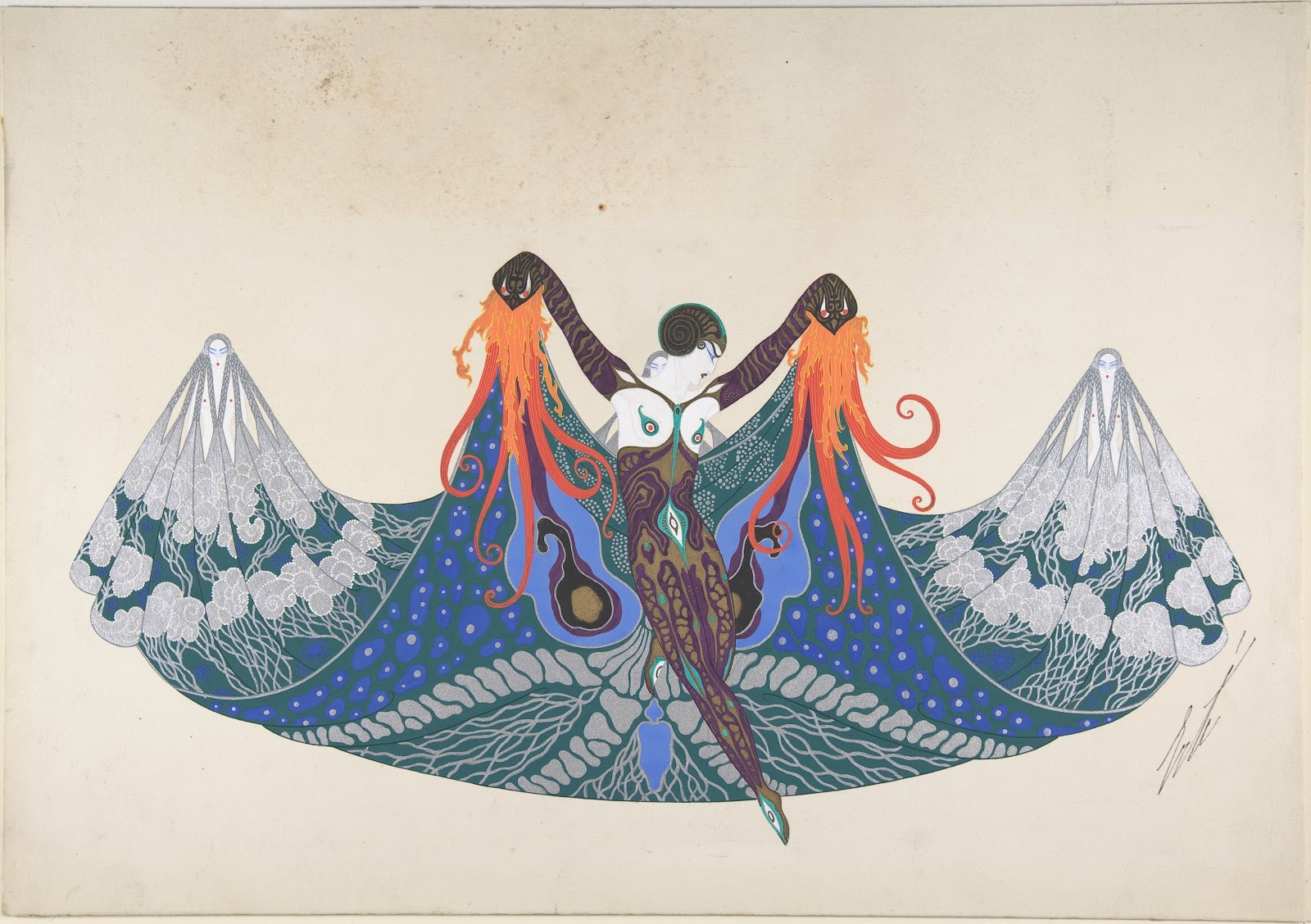
Costumes:


“The Arctic Sea”, 1925


Wedding costume for Aladin , 1929

Costume for the wife of a Russian boyar; The Woman and the Devil at the Théâtre Apollo, 1921


Costume for Pelléas et Mélisande, 1927 

Set Designs:

Design for Stage Set, City Skyline Seen Beyond Terrace, for Manhattan Mary, 1927


To see more theater set designs, click here


Erté and the Ziegfeld Follies


The Ziegfeld Follies were famous for many beautiful chorus girls commonly known as Ziegfeld girls.  


Florenz Ziegfeld's theatrical spectaculars known as the Ziegfeld Follies, were based on the Folies Bergère of Paris.... Erte costumes and sets were featured in the Ziegfeld Follies of 1923.


 Erté's theatrical innovations were countless, including "living curtains" (showgirls with plumes and pearls, festooned by embroidered trains. The Ziegfeld girls paraded up and down flights of stairs semi-nude, as anything from birds to battleships.


 These beauties, of similar size, decked out in Erté designs, gained many young male admirers and they became objects of popular adoration.


Prints and More Work (costumes, sets, apparel, etc.)

The alphabet and numeral suite:


For the complete alphabet and numeral suite, click here


Work from the Metropolitan Museum of Art


To see images from the Metropolitan Museum of Art, click here


Erté continued working throughout his life, designing revues, ballets, and operas. He had a major rejuvenation and much lauded interest in his career during the 1960s with the Art Deco revival. He branched out into the realm of limited edition prints, bronzes, and wearable art.

Erté's work has exhibited in prominent museums around the world including the Metropolitan Museum of Art in New York, the Los Angeles County Museum in California, The Smithsonian Institute in Washington, D.C., The Victoria and Albert Museum in London, and more. Erté is credited as being the originator of the Art Deco Movement and is the style for which he is identified.


To see more of Erte's work, click here